Saturday, May 12, 2018

Mount Carmel

Mount Carmel is not a particular mountain peak, but a mountain range, stretching from Haifa, on the Mediterranean coast, east and south along the Jezreel Valley.  The prophet Elijah spent a lot of time in the area of Mount Carmel and Biblical historians believe he lived for a time in a cave in the mountain, which has now been turned into a shrine.

Mount Carmel is also where Elijah challenged the 450 prophets of Baal to a "duel".  Each side would build an altar and place a slaughtered bull on it.  Then the God who burned up the sacrifice would be the true God.  Try as they might, the prophets of Baal could get no response from their god.  When it was Elijah's turned, he had had a trench dug around the altar and then had the altar, the bull, and the trench drenched with water.  The God of Israel responded with fire from on high and burned up not only the sacrifice, but the stone altar, and all the water in the trench.

There are a couple of sites that history has pointed to as possibly being the location of this challenge, but the one viewed by most historians in on top of the mountain where a Carmelite monastery, Deir al-Muhraka, is located.  Why this spot?  Because of what happened next, after Elijah had all 450 prophets of Baal killed.  There had been a drought in the land and Elijah told his servant to look towards the sea for rain.  The servant had to look seven times, but then he saw the rain cloud, and with it, the end of the drought in Israel.  On a clear day, from the spot where the monastery has been built, you can see the Mediterranean.

From the top of Mount Carmel, looking southeast into the Jezreel Valley

Looking south from the top of Mount Carmel

In the middle of the Jezreel Valley is an Israeli Air Force base.

Looking west towards the Mediterranean Sea

On the roof of the Monastery

At the top of the monastery.  A simple cross, a simple life.

A statue of Elijah in the courtyard of the Deir al-Muhraka monastery.  I think he is standing on the head of one of the prophets of Baal.

Magdala

Magdala, an ancient town on the shores of the Sea of Galilee, is believed to be where Mary Magdalene, a follower of Jesus mentioned in all four Gospels, and present at his death, burial and resurrection, was from.

For years the exact location of the town was not exactly known.  But then, during construction of a Catholic retreat center, relics were found!  In Israel, whenever relics are found, all construction must stop and the archaeologists are called in.  Excavations found not only the town, but an ancient synagogue, called the Migdal Synagogue, believed to be the oldest synagogue found in Galilee.  Also found was a carved stone block, called the Magdala Stone, with detailed carvings of the 2nd Temple in Jerusalem, as well as a carving of a seven branched Temple Torah.  It is the earliest carving of a menorah to be found outside of Jerusalem.

A Catholic Church is built on the site with a number of different chapels.  Four of the chapels have mosaics on the back wall depicting events from the life of Jesus.  Another chapel, called the Encounter Chapel, has a large, very powerful, mural of the woman with issue of blood touching the hem of Jesus' robe.

Excavated ruins showing a small table and mosaic floor

A mosaic floor found in the ruins


The main chapel in the Catholic Church is called the Boat Chapel, with a boat for the altar and a large window behind it allowing you to see the Sea of Galilee.  Sitting in the congregation, and squinting your eyes, you can almost see the boat floating on the water.

Walking on the Water Chapel

Mary Magadelene Chapel

Daughter of Jairus Chapel

The Fishers of Men Chapel

A panorama of the mural in the Encounter Chapel, showing the woman with the issue of blood touching the hem of Jesus' robe

This painting of Mother Teresa was outside the Encounter Chapel

Looking into the Boat Chapel from the Sea of Galilee side of the church


The Sea of Galilee

The Sea of Galilee, also known as Lake Gennesaret, and called Kinnerat today, is a large, freshwater lake that sits about 675 feet below sea level.  It is the largest fresh water lake below sea level in the world.  It is about 13 miles long, and 8 miles wide, and is bordered by Israel on the North, West, and South, and the Golan Heights on the east.  Underground springs, and the Jordan River, flowing into it from the north provide its source of water; and the Jordan River then flows out of the southern end, providing irrigation to farmland, and water to the country of Jordan.  Due to drought conditions that began in 2013, in 2018 the water level in the lake is expected to reach its lowest point since 1926.

Much of the ministry of Jesus occurred around, and on, the Sea of Galilee.  Including Jesus (and Peter) walking on the water, Jesus calming the storm, and Jesus directing the disciples where to fish after his resurrection.

While we were there, the lake was very calm and peaceful.  It was almost difficult to imagine a storm similar to the ones described in the first two examples above.  However, as you'll see in a couple of photos below, There is a deep valley on the northwest edge of the lake, with Mount Arbel on one side.  That valley essentially runs out to the Mediterranean Sea.  Storms from the Mediterranean can funnel down this valley bringing high winds and rain and causing the waters of the lake to change from calm to stormy very quickly.

A calm and peaceful Sea of Galilee

In the background is the hillside where many historians believe Jesus preached the Sermon on the Mount.  The large grey area is banana orchards covered by a sun shade.  Just above that is a white building with a green roof.  That is a Roman Catholic Franciscan chapel.


The city of Tiberias, located on the western shore of the Sea of Galilee has a little over 40,000 residents.

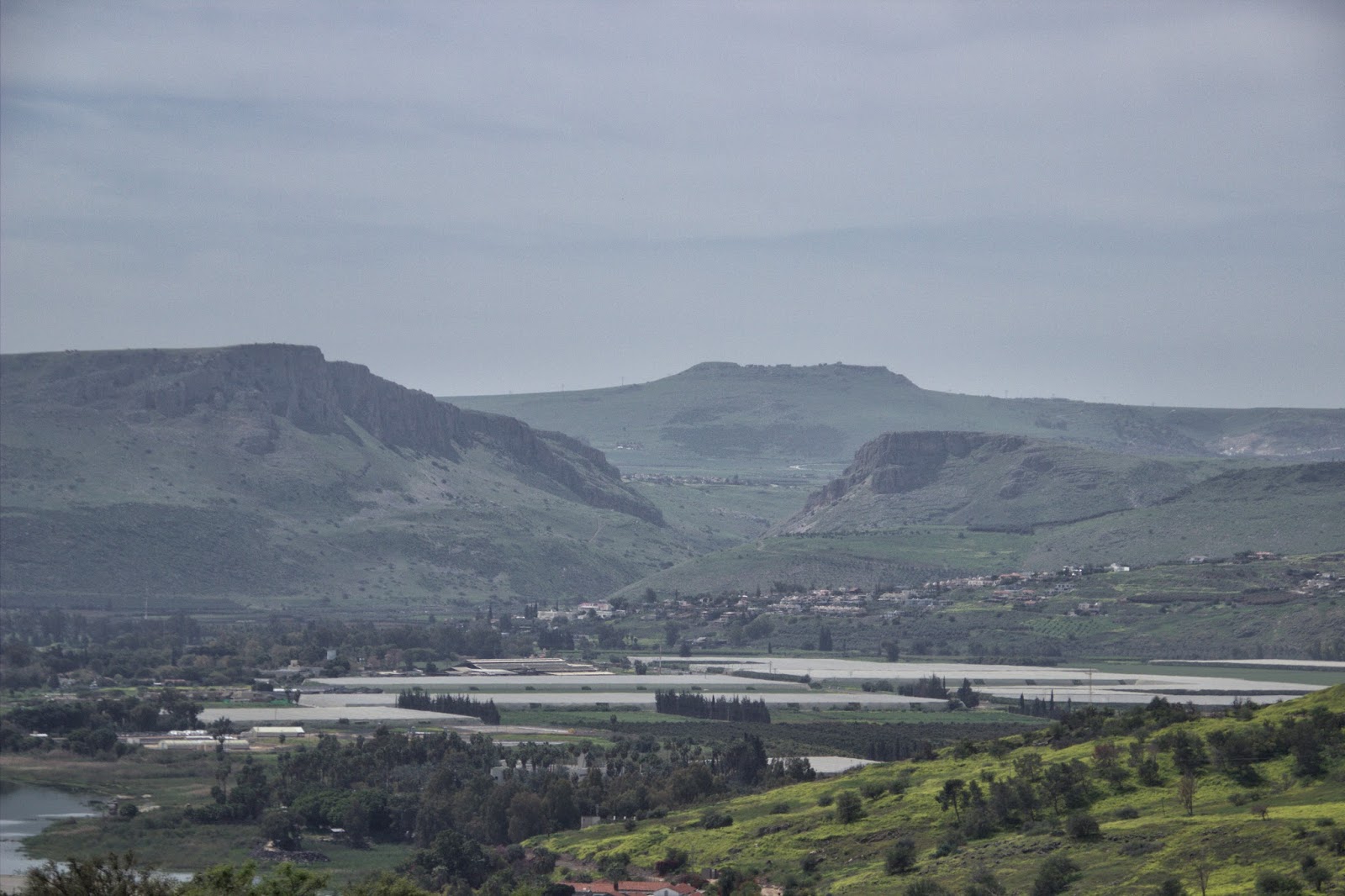
Taken from the Mount of Beatitudes, you can see Mount Arbel on the left, and the valley that can bring storms from the Mediterranean into Galilee.

Another view of Mount Arbel, on the left, from out on the Sea of Galilee.

Discovered in 1986, the remains of this fishing boat have been dated back to between 50 BCE and 50 CE based on a cooking pot found in the boat, the nails used in the boat, and radiocarbon dating.

The boat is 27 feet long, 7 1/2 feet wide, and made up of ten different types of wood.  Archaeologists suggest the boat could have been made during a wood shortage, or made of scrap pieces, or repaired and patched numerous times using different wood.

A model of what the fishing boat would have looked like.


Friday, May 11, 2018

The Mount of Beatitudes

The Mount of Beatitudes, located on the northern shore of the Sea of Galilee between Capernaum (see post below) and Magdala (see a previous post), is where historians believe Jesus preached the Sermon on the Mount.  As with most historical Biblical sites, the exact location is not known.  But this grass-covered hillside, rising up from the Sea of Galilee, is not difficult to imagine as being the place.

Today there is a Roman Catholic Franciscan chapel on top of the hill that was built in the late 1930's.  In 2000, Pope John Paul II celebrated mass on this hillside.

Looking over the Sea of Galilee from the top of the Mount of Beatitudes

A panorama of the Sea of Galilee from the top of the hill.  The hills on the left side of the photo are the Golan Heights.  The big netted area on right side is a banana orchard.  The bananas are covered with a sunscreen to help them not to ripen too quickly.

The Franciscan chapel


Looking up the hillside from the road down below.  The Franciscan chapel in on the right edge of the photo.

More bananas!

Bananas almost ready for market

Capernaum

Capernaum is a small town on the north coast of the Sea of Galilee.  In Biblical times it was a fishing village and was home to Jesus' disciples Peter, Andrew, James, John, and Matthew.  Capernaum was also where Jesus based his ministry after leaving his hometown of Nazareth (see next post).

The Bible records a number of miracles being performed by Jesus in Capernaum; including delivering a man of a demon in the synagogue, healing Peter's mother-in-law of a fever, and healing the paralytic who was lowered through the roof.  The servant of the Roman Centurion who was sick and healed by Jesus was also in Capernaum.

Even though Jesus did so many miracles in Capernaum, apparently the hearts of the majority of the townspeople were not changed because Matthew records in his Gospel that Jesus condemned the town and said that even Sodom (of Sodom & Gomorrah) would fair better on judgement day.

Today in Capernaum you can see the ruins of a 4th century synagogue (nicknamed the white synagogue) that is built on the foundation of a 1st century synagogue.  Since there was only one synagogue in town, it is very possible that the 1st century synagogue is where Jesus often preached, and cast the demon of of a man (see above).  You can also see the 1st century ruins of part of the town of Capernaum, and what many historians believe is the ruins of Peter's house.


Stove carvings


The foundation of the 1st century synagogue are the dark stones, with the 4th century synagogue built on top.


Looking in through the back wall of the 4th century synagogue

Columns in the synagogue


Similar to the Western Wall of the Temple Mount in Jerusalem, worshipers have written out their prayers and stuffed them into the cracks of the back wall of the ancient synagogue.

Ruins of a 1st century home in Capernaum

Ruins of the village

A mosaic tile floor found during the excavations

The ruins of Simon Peter's home in Capernaum.  The dark colored joists above the ruins are holding up a Catholic Church, with a  glass floor, built over Peter's house.

A statue of St. Francis of Assisi