Saturday, April 28, 2018

The Upper Room

Like most holy sites in Israel, and especially in Jerusalem, not everyone agrees on the exact location of what happened where.  The Upper Room, the scene of the Last Supper, Jesus washing the feet of the disciples, Judas leaving the meal early, etc., is no different.  The actual building, and room, vanished long ago.  However, this particular building (and room), most likely built before 400 CE, is believed by many historians to be built on the site of the original Upper Room.

The site was supposedly maintained by early Christians, including the Crusaders, until approximately the 1330s when it came under the control of Franciscan Friars.  They oversaw the site until 1524 when the Ottoman's gained control and turned it into a mosque.  You can still the influence of the Ottomans in the building's architecture.  After Israel became a state in 1948, the government took control of the site and Christians began to return to it.


Arabic inscription above the entryway 

The ceiling

Lamps above one of the alcoves

Details of the top of the columns

One of two stained glass windows


Arabic inscription in tiles on the wall

A mihrab.  Semi-circular niches similar to this are found in mosques around the world.  Stepping inside it, one will find themselves pointing to Mecca, the holy city for Muslims.

Back to the light

Friday, April 27, 2018

Sunrise over Jersualem

Dawn comes to Jerusalem, as seen from our hotel window


The Southern Wall and Steps

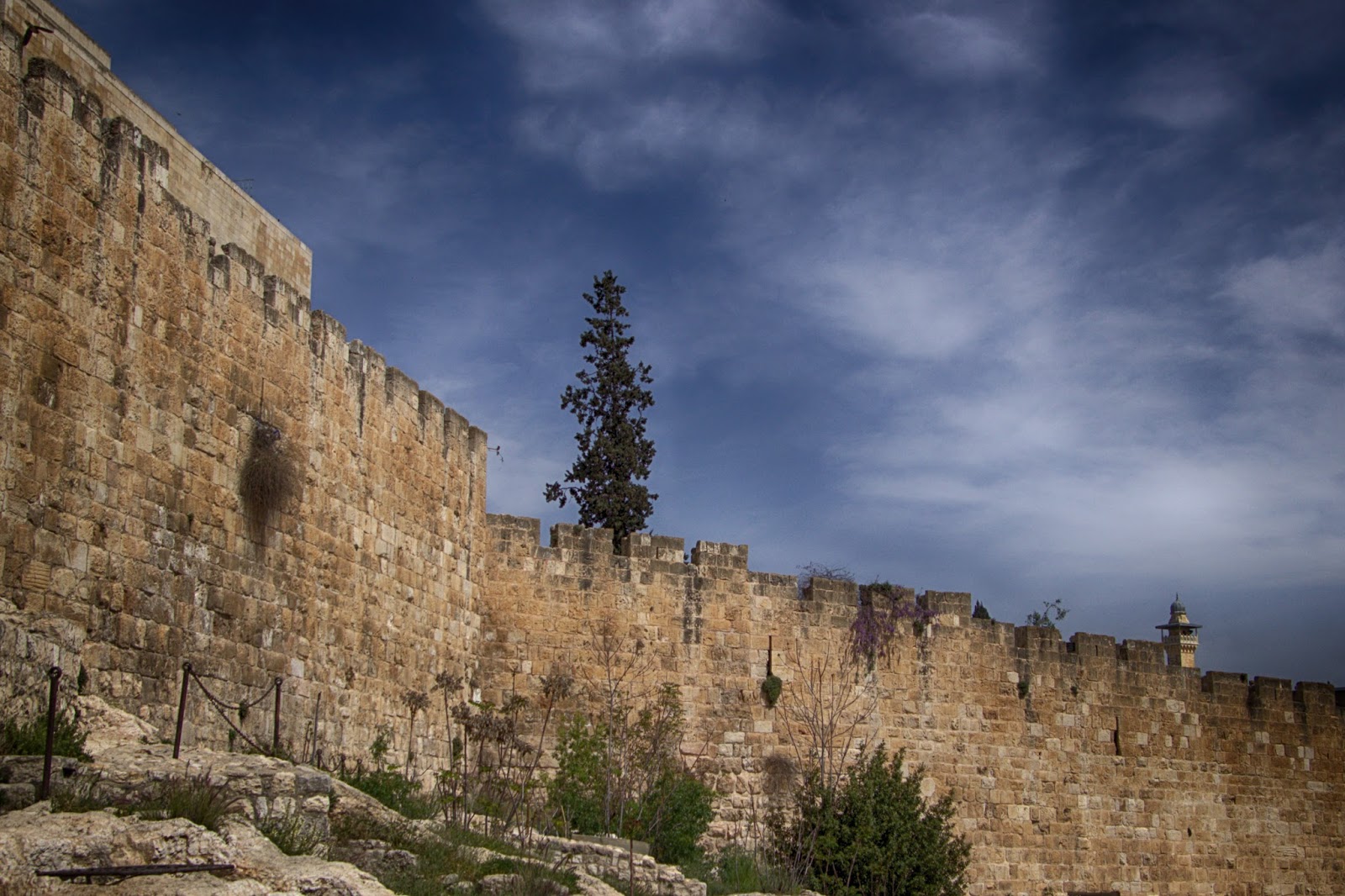
The Southern Wall of the Temple Mount, and its set of steps, were the main way into the Temple for the common Jew.  Deuteronomy 16:16 reads: "Each year every man in Israel must celebrate these three festivals: the Festival of Unleavened Bread, the Festival of Harvest, and the Festival of Shelters. On each of these occasions, all men must appear before the Lord your God at the place he chooses, but they must not appear before the Lord without a gift for him."  Once the Temple was completed in Jerusalem, that "place" chosen by the Lord was the Temple.

Before entering the temple, a worshiper was expected to cleanse himself with a ritual bath in a mikveh (see photos below).  Then they would climb the steps on the south side of the Temple Mount and enter through the Huldah Gates.  There was a set of three gates on the right side of the wall (the Eastern Huldah Gates) and two gates on the left side of the wall (the Western Huldah Gates).  The gates actually led the worshiper into a tunnel which would bring them down underneath the Temple, and then upwards to the courtyard.

As you can see from the pictures on the signs below, the steps were quite long.  At each of the festivals, there were probably thousands of people on these steps preparing to enter the Temple, or exiting it.

A number of scholars believe that these steps were also where the Church, in Acts 2, had its beginning (rather than the Upper Room).  During the Feast of Pentecost, also called the Feast of Weeks, there would have been thousands of Jews on these steps making their way into the Temple.  Including Peter and the disciples, because 9am was the time for morning prayers!  Just one more thing to think about!

An artist's rendering of the southern wall of the Temple Mount and its steps.  Note the three gates on the right side and the two gates on the left side.


This is a scale model of the Old City of Jerusalem, and Second Temple, that is on the grounds of the Israel Museum.  You can see the Southern Wall and Steps, and in the lower right-hand corner, one of the western Hulda Gates.

Looking down the wall towards the Mount of Olives


The steps that remain

Some of the steps are original to the 2nd Temple period - i.e. the 1st century!

Worshipers purified themselves, before climbing the steps to enter the Temple, in a Mikveh bath


Looking down into an excavated Mikveh.  Approximately 50 Mikvehs have been uncovered by archaeologists in the southern wall area of the Temple Mount


The three Hulda Gates on the eastern side of the Southern Wall

A close up shot

One half arch is all that remains of the Hulda Gates on the western side of the Southern Wall.


A close-up of the half arch

A little easier to see the details on the arch

In the time of the 2nd Temple (also called Herod's Temple) the building known as Solomon's Colonnade (see the photo of the model of the Temple Mount, and Solomon's Colonnade above) was on top of the Southern Wall.  Today, there is a building associated with the Al Aqsa mosque.  You can see a bit of the dome of the mosque in the upper left-hand corner.
Shot from the City of David, this photo shows the Al Aqsa mosque, fragment of the western Hulda Gate, and some of the Southern Steps.

This is the perpendicular wall that runs out of where the two Hulda Gates on the western side of the Southern Wall were

The Al Aqsa mosque

The al-Fakhariyya minaret.  One of four different minarets on the Temple Mount
A shot of the al-Fakhariyya minaret and the dome of Al Aqsa mosque, on top of the Temple Mount

The Dome of the Rock shrine can be seen on top of the Temple Mount

The Bab al-SilSila minaret on top of the Temple Mount

Another shot of the al-Fakhariyya minaret

Flowers with the Al Aqsa mosque in the background


Sunday, April 22, 2018

The Western Wall

The Western Wall, also know as the Wailing Wall, or the Kotel; is one of the most sacred sites in all of Judaism.  It is actually a part of the retaining wall of the Temple Mount, built by Herod the Great between 19 BCE and 4 BCE.  The wall is on what was the west side of the Temple Mount and is believed to be the closest wall to the Holy of Holies, when the second Temple was on top of the mount.

In Judaism, the Western Wall is revered as the sole remnant of the Temple. It has become a place of pilgrimage for Jews, as it is the closest permitted accessible site to the holiest spot in Judaism, the Foundation Stone, which is located on the Temple Mount (inside the Dome of the Rock).

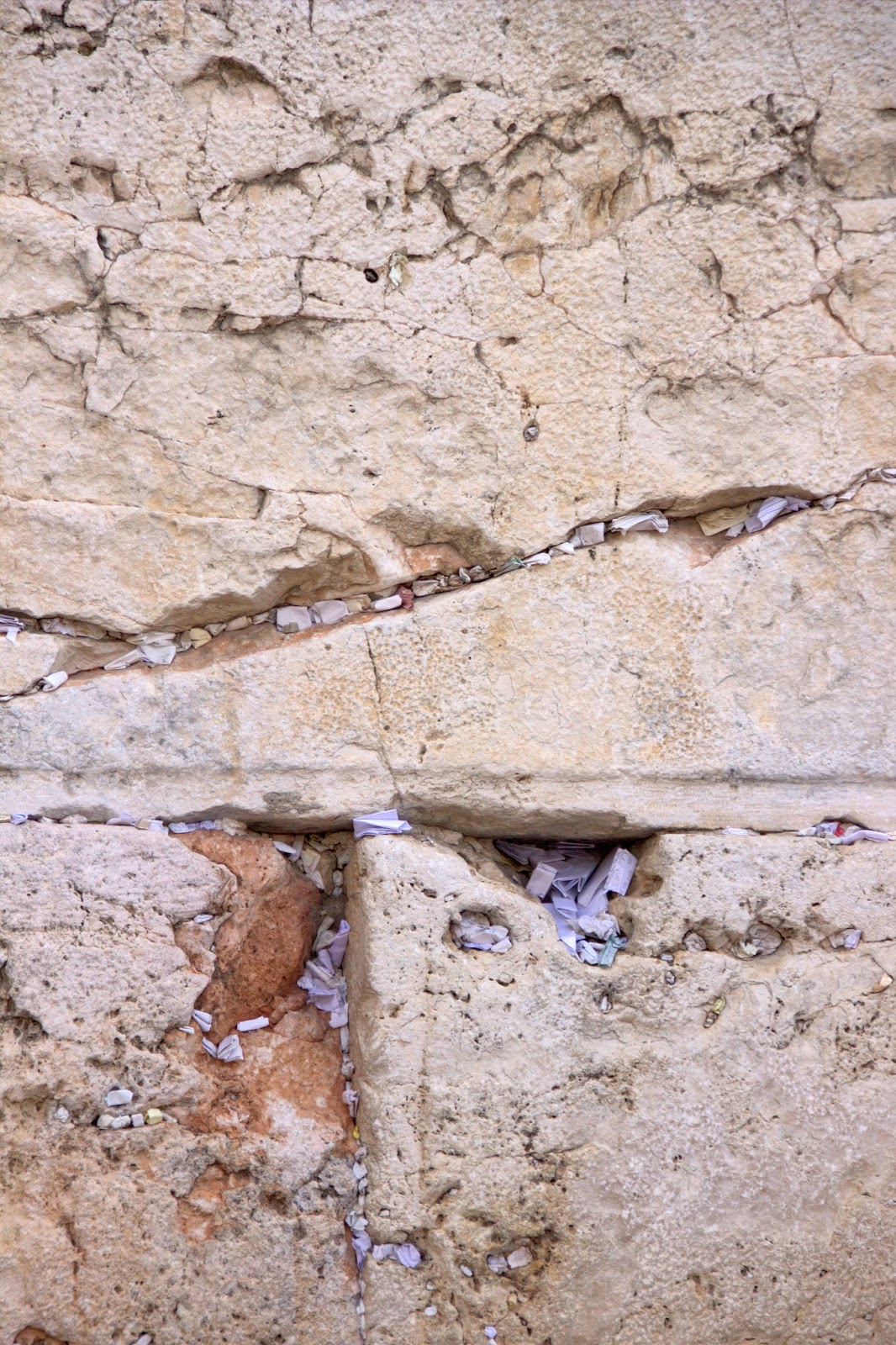
You can see Jews praying at the wall each day, as well as many Christians.  Many write prayers on slips of paper and insert them into the cracks of the walls.  Since I have returned from our trip, many have asked what impressed me the most about Israel.  I have to say it was the Western Wall.  To see people standing with their face to the wall, intently focused, was very moving.  While many may see this as legalistic, I only saw honest, and devoted, worshipers of the Lord.  I found it difficult to take pictures here, not because it was not allowed, it is allowed.  But I felt almost as if I was intruding on someone's personal conversation with the Lord.  I'm thankful that with a telephoto lens I could stand in the background, and was hopefully as unobtrusive as possible.

This is a scale model of the Old City of Jerusalem, and Second Temple, that is on the grounds of the Israel Museum.  The arrow pointing to the Western Wall actually points at the location on the wall where Jews pray today, and where these photos were taken.  You can understand from its proximity to the backside of the Temple (and therefore the Holy of Holies) why this spot is sacred to Judaism. 


Prayers written out and stuffed into the cracks of the wall


Reading the Word

Deuteronomy 6:6-9 reads "These commandments that I give you today are to be on your hearts. Impress them on your children. Talk about them when you sit at home and when you walk along the road, when you lie down and when you get up. Tie them as symbols on your hands and bind them on your foreheads. Write them on the door frames of your houses and on your gates.


This photo reminded me of a friend of mine.  Many years ago he nicknamed his bed "the Word".  Then, when he wanted to take a nap, and someone called on the phone for him, his wife could honestly say, "he can't come to the phone right now because he's in 'the Word'".


War & Peace at the Western Wall

A painting we bought showing "prayers like incense" rising from the Western Wall